
The Cloud Doesn't Float. It Drinks.
Every digital convenience consumes something physical. We just stopped asking what.

People call it the cloud.
A word so carefully chosen that it hides the most important fact.
Clouds don’t consume resources.
Data centers do.
Every photo you never delete.
Every AI prompt.
Every backup.
Every streaming session.
Every email.
Lives inside buildings that require enormous amounts of electricity, land, and water just to exist.
The cloud isn’t floating above us.
It’s drawing from beneath someone else’s feet.
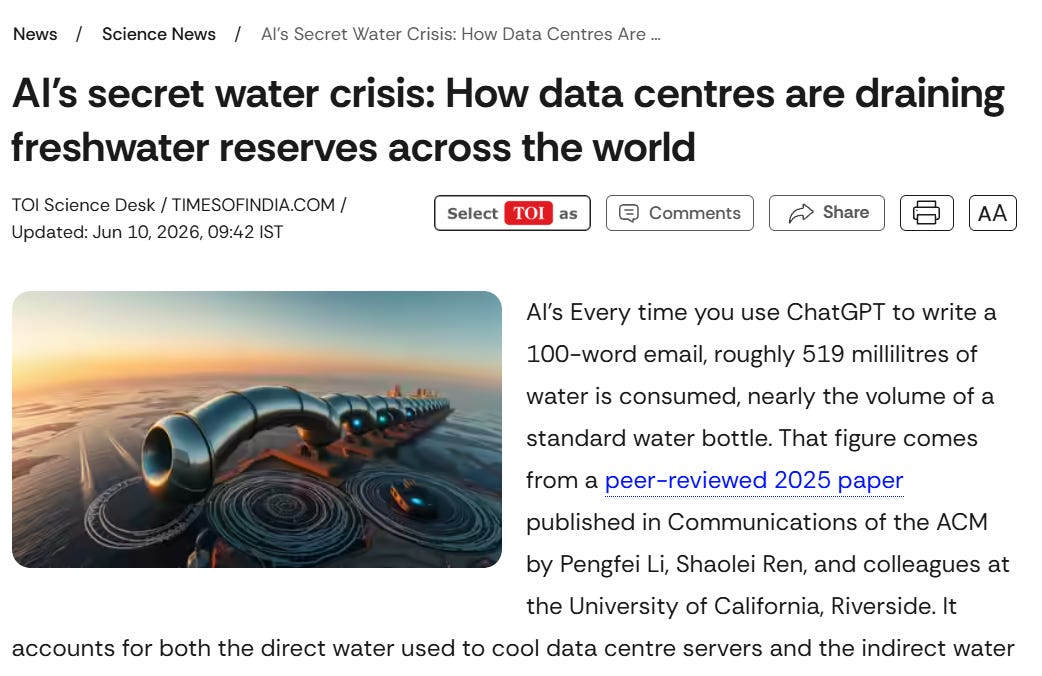
For decades, we’ve celebrated the digital world because it seemed to free us from the physical one.
Books became e-books.
Letters became emails.
Cabinets became cloud storage.
Meetings became video calls.
Everything felt lighter.
Cleaner.
Almost immaterial.
But digital never meant immaterial.
It simply meant the infrastructure moved somewhere we no longer had to see.
Every search query travels through servers.
Every AI response generates heat.
Every backup is copied, synchronized, indexed, and stored across machines that never sleep.
Heat has always been the hidden tax on computation.
Water became one of the ways we pay it.
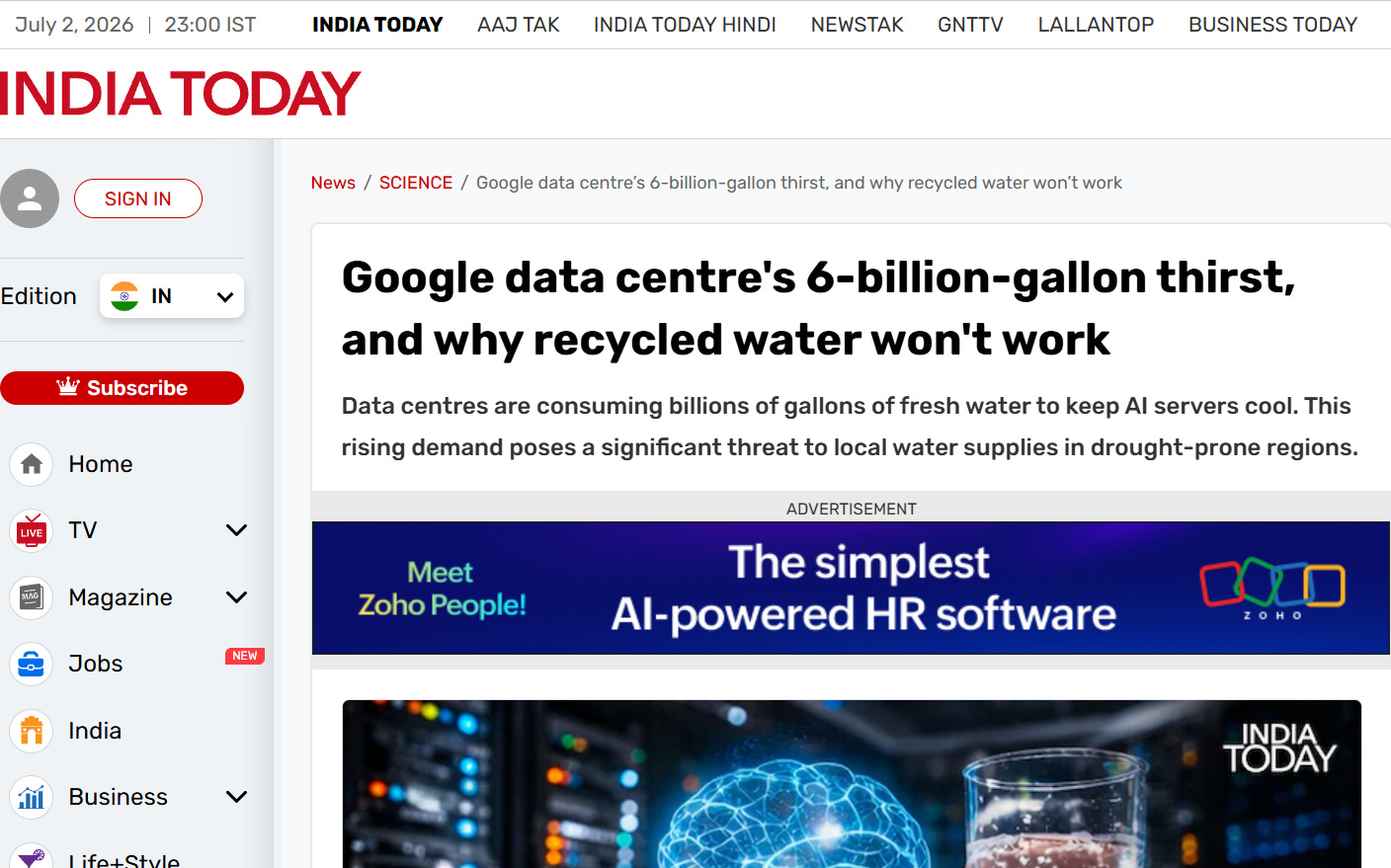
Google’s data centers alone consumed more than 6 billion gallons of water in 2023, and usage has continued to rise as AI workloads expand. One of its facilities in Iowa used roughly one billion gallons in a single year. Meanwhile, researchers project that U.S. data-center water consumption could increase dramatically over the next few years as AI infrastructure scales.
That cost rarely appears on our screens.
It appears somewhere else.
In rivers.
In reservoirs.
In municipal water systems.
In aquifers shared with nearby communities.
The cloud feels infinite only because its limits exist beyond our field of view.
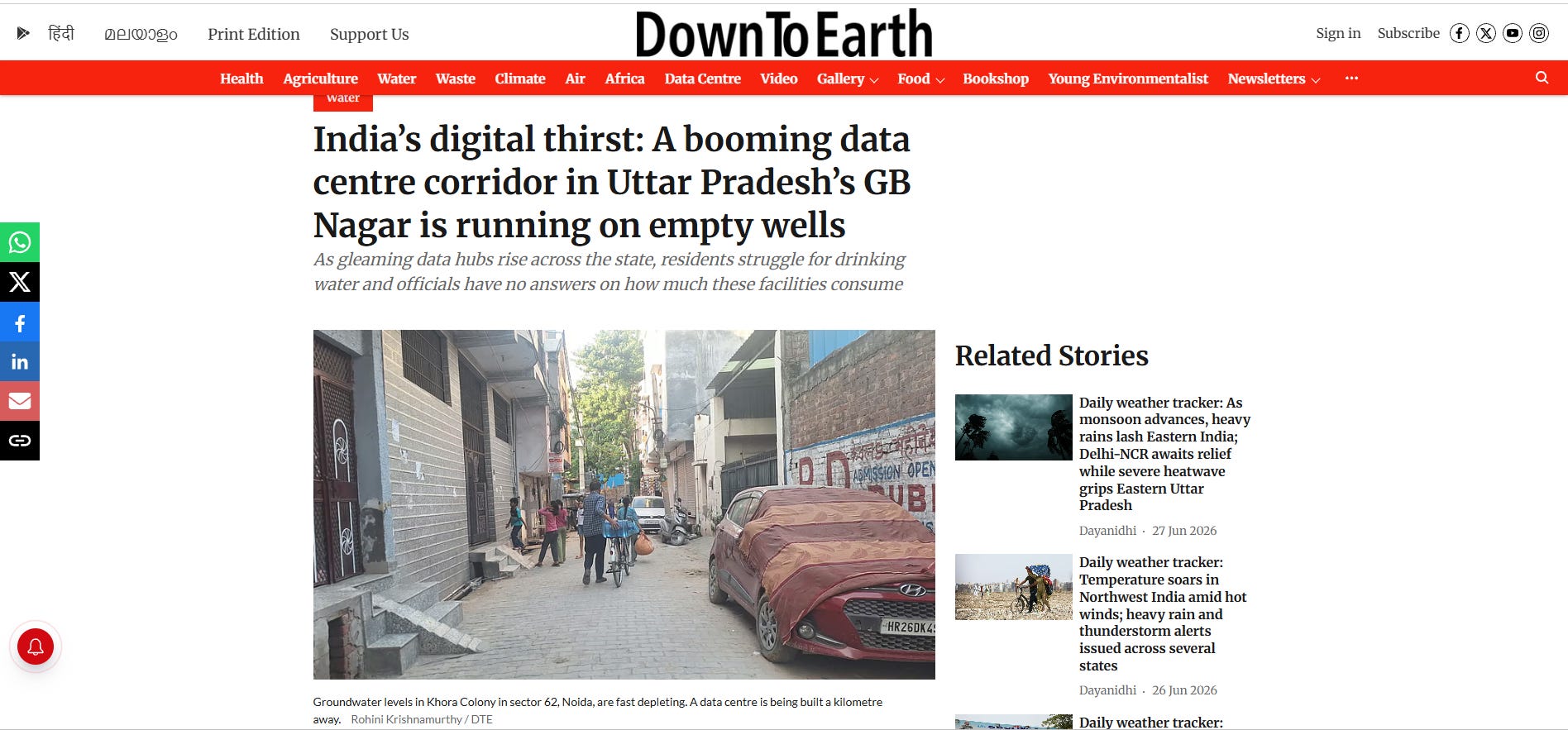
In Khora Colony, near Greater Noida, those limits are becoming visible.
Many residents now depend on water tankers because groundwater has fallen significantly over the past two decades.
Just a few kilometers away, Greater Noida is rapidly becoming one of India’s largest data-center hubs.
Most residents will never enter these facilities. Many don’t even know they’re there. Yet both depend on the same finite resource.
Water.
The issue isn’t that data centers use water.
Every industry consumes resources.
The real question is different.
What costs are being pushed out of sight to make digital progress feel free?
Every civilization has hidden its infrastructure.
Roads disappear beneath asphalt.
Electricity arrives through wires buried underground.
Waste vanishes into pipes.
Now computation disappears into “the cloud.”
Convenience has always depended on making complexity invisible.
The cloud may be the most successful example yet.
Billions of people use it every day without ever asking where it lives.
There’s another irony.
Most of us contribute to the problem without realizing it.
Thousands of screenshots.
Duplicate photos.
Videos we’ll never watch again.
Files we keep because deleting them feels harder than storing them.
Individually, they seem insignificant.
Collectively, they become infrastructure.
Every unnecessary file asks to be stored.
Backed up.
Replicated.
Indexed.
Protected against failure.
Available instantly.
Not once.
Continuously.
Cheap storage changed our behavior.
We stopped deciding what deserved to remain.
The cost isn’t just storage.
It’s everything that follows.
Processing.
Networking.
Cooling.
Redundancy.
Maintenance.
Searching.
Every additional byte asks thousands of machines to remember it indefinitely.
The cloud doesn’t merely store our data.
It continually works to preserve it.
This isn’t an argument against AI.
Or cloud computing.
Or data centers.
Modern society depends on them.
It’s an argument against treating digital accumulation as if it were free simply because we don’t pay for its consequences directly.
The cloud has always had a physical address.
We just gave it a name that made us forget.
For years, people compared data to oil.
Maybe the better comparison is infrastructure.
Useful.
Transformative.
Necessary.
But never invisible.
Every technological revolution changes what becomes scarce.
The Industrial Revolution made clean air scarce.
Mass manufacturing increased demand for raw materials.
The AI era is making energy, water, and compute the resources we’ll have to manage with far greater care.
Technology doesn’t eliminate physical limits.
It simply moves them.
“We shape our tools, and thereafter our tools shape us.” — Marshall McLuhan
Perhaps the cloud has shaped us in one unexpected way.
It taught us to believe that digital means weightless.
It never did.
One thing to try today
Open your cloud storage.
Not to free up space.
To ask a different question.
“If this disappeared tomorrow, would anyone-including me, notice?”
If the answer is no, perhaps the most sustainable byte is the one that never needed to be stored.